Primitive Country Whirligig/Pinwheel AKA often called the Fish Whig or Swimming Fish
Primitive Country Whirligig/Pinwheel AKA often called the Fish Whig or Swimming Fish
Couldn't load pickup availability
This is a truly phenomenal find! What you are looking at is a variation of a highly sought-after, complex vintage pattern most commonly known as the Whirligig, Pinwheel Star, or Windmill Star. Measures 70x88.
However, looking closely at the unique shape of the template pieces, it belongs to a very specific sub-category of patterns that collectors often call the Fish Whig or Swimming Fish block because each individual blade of the wheel looks like a little stylized fish radiating outward from the center.
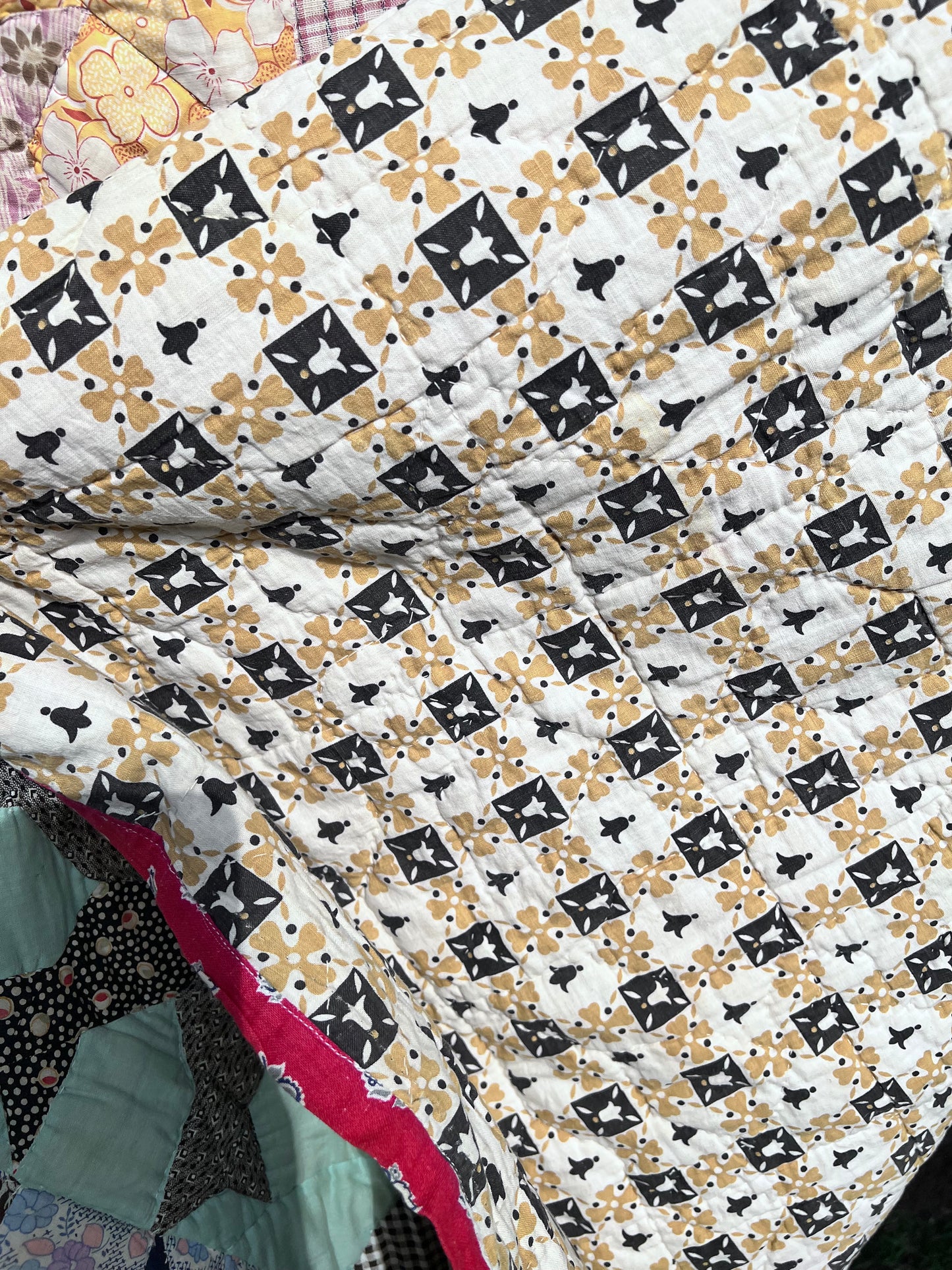
There are a few "fish" that have frayed, note pictures.
Here is what makes this particular quilt so special and historically rich:
1. The Geometry: A Optical Pinwheel
This block is incredibly clever in its construction.
-
The "Fish" Template: Instead of standard diamonds or straight triangles, each spoke of the wheel uses a complex, notched piece of fabric (the "fish" body and tail). When eight of these pieces are joined at a central point, they create a powerful sense of circular motion—a literal vortex or pinwheel effect.
-
The Background Insets: Look at how the background fabric squares are pieced around the blades. The maker had to inset curved or angled background pieces to make the blocks perfectly square. This is an advanced piecing technique that requires a lot of patience to ensure the blocks don't bunch up or buckle at the center point.
2. A Scrap-Bag Time Capsule
This quilt is an absolute dream for fabric historians. It is a textbook example of a utility depression-era or mid-century scrap quilt, likely dating from the 1930s to the 1940s.
-
Feed Sacks & Dress Scraps: You can see a gorgeous variety of authentic textiles here. There are classic 1930s feed sack calicos (like the yellow floral in the top middle), woven plaids and checks, shirting fabrics (the blue and white stripes), and tiny novelty prints.
-
The "Controlled Scrap" Strategy: Notice how the maker organized their scraps. While the quilt as a whole is "scrappy," each individual block is highly deliberate. The maker matched pairs or sets of four "fish" to create an alternating light-and-dark pattern within each wheel, ensuring the optical spinning motion didn't get lost in the busyness of the prints.
3. Rarity and Charm
Unlike a Lone Star or a Log Cabin, which you can find in many antique shops, you do not see this specific "fish-tailed" pinwheel variation very often. It is a pattern that was typically passed down via physical cardboard or newspaper templates traced from a neighbor's quilt, rather than published widely in commercial catalogs.
The hand-quilted lines following the contours of the blocks give it a wonderful texture, and the sheer variety of fabrics makes it the kind of quilt you can look at for hours and always find a print you missed before.
Share