Highly traditional quilt - the Jacob's Ladder, Stepping Stones or Trail of the Covered Wagon Vintage Quilt
Highly traditional quilt - the Jacob's Ladder, Stepping Stones or Trail of the Covered Wagon Vintage Quilt
Couldn't load pickup availability
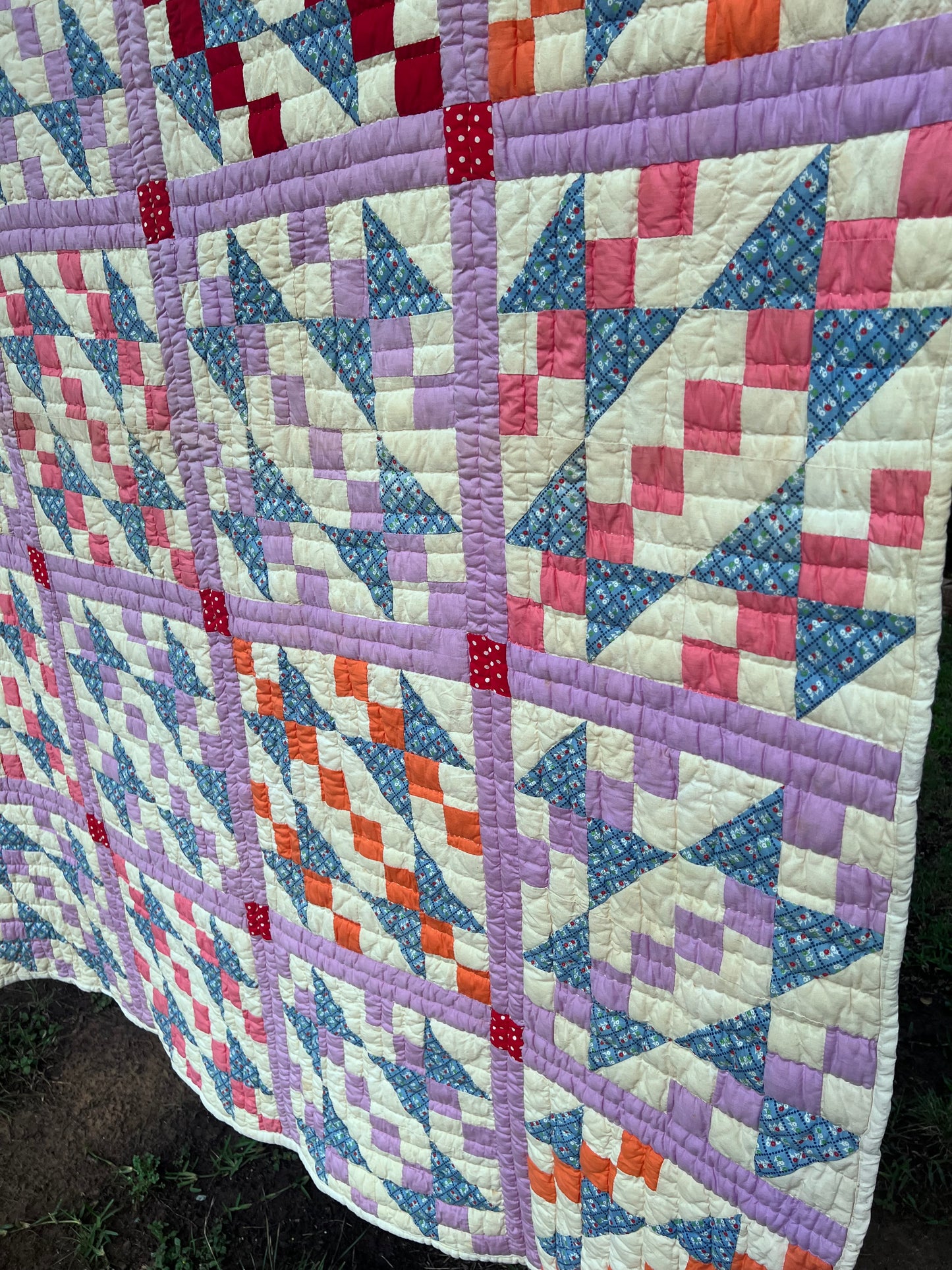
This quilt is a wonderful, highly traditional design known as the Jacob's Ladder pattern (historically also called Stepping Stones, Trail of the Covered Wagon, or The Underground Railroad). Measures 62x83 and is a medium weight quilt.
This particular piece is a brilliant lesson in how a quilter can use a controlled, repeating element to tie together a joyful variety of colors. Here is a breakdown of its design, construction, and historical character:
1. The Geometry: Simple Units, Complex Paths
The magic of a Jacob's Ladder block lies in its layout, which is built on a simple 3x3 grid (a nine-patch construction). Each individual block is made by combining two basic elements:
-
The Checkerboards: Small squares sewn together in alternating colors to create a stepped, staircase effect.
-
The Half-Square Triangles (HSTs): Two contrasting triangles sewn together to form a square.
When these blocks are sewn together, the sharp diagonal lines of the triangles create a strong geometric zig-zag pattern that cuts across the quilt, while the checkerboards appear to weave over and under the paths, giving the entire piece a beautiful sense of continuous motion.
2. The Clever Layout Strategy
What makes this specific quilt stand out is the maker's clever use of color theory:
-
The Constant Element: The quilter kept the half-square triangles completely uniform across the entire quilt, using the exact same blue-and-white floral calico print for every single star-like point.
-
The Varied Elements: To bring the quilt to life, the maker varied the checkerboard sections block-by-block. As you look around the center intersection, you can see a lavender block, a bubblegum pink block, and a vibrant orange block.
By keeping the blue triangles constant, the quilt remains visually anchored and doesn't become chaotic, despite the high-contrast shift in the other colors.
3. The Framing: Sashing and Polka-Dot Cornerstones
The block layout is beautifully separated by a solid lavender sashing (the strips running between the blocks). The sashing strips are quilted with straight utility lines that contrast nicely with the dense, organic quilting inside the blocks themselves.
At the crossroads where the four blocks meet, the maker inserted a punchy, bright red cornerstone fabric featuring small white polka dots. These little pops of red act like exclamation points across the surface of the quilt top.
4. The Era: 1930s Great Depression
The fabric choices tell a very clear story of the 1930s:
-
The blue fabric is a textbook example of a Depression-era feed sack print, featuring tiny, stylized red and white flowers on a medium blue ground.
-
The solid pastel lavender, soft pink, and companion orange are the definitive color palette of the 1930s quilt revival. During this difficult economic era, these cheerful, sunny solid cottons were widely sold in dry goods stores to bring light and brightness into the home.
The crisp alignment of the tiny checkerboard squares and the sharp points of the triangles show that this maker possessed fantastic precision and a wonderful eye for color placement!
Share